
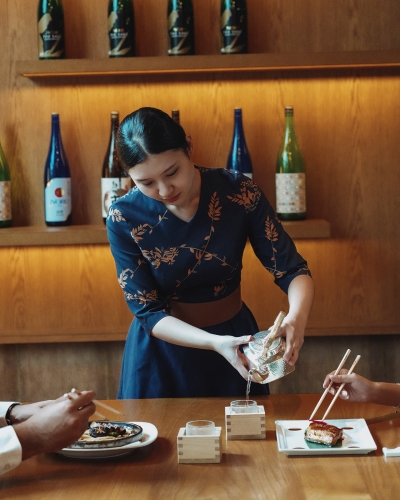
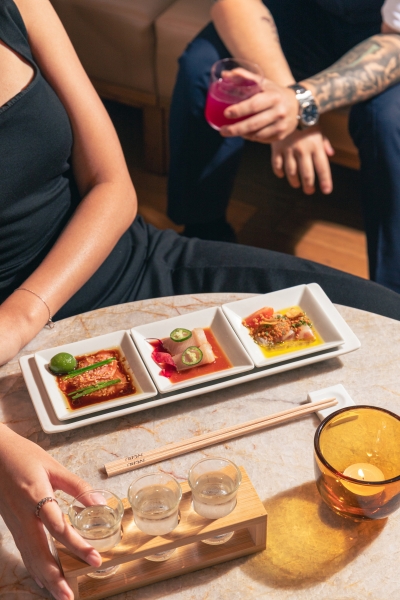
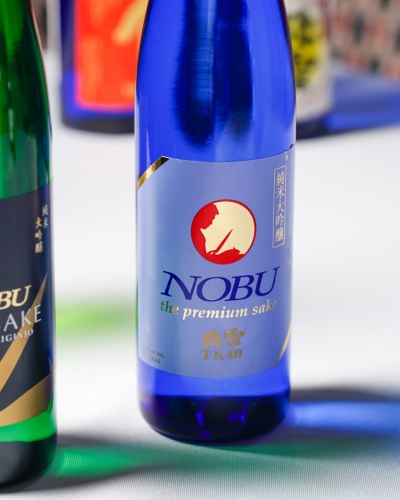
As dusk settles over Orchard Boulevard, Nobu Bar at Four Seasons Hotel Singapore reveals itself as a quiet alcove of warmth and refinement. This is a place where evenings unfold gently, guided by craft, culture, and the subtle elegance of Japanese tradition. Beneath soft lighting and polished wood, one of Nobu’s most celebrated signatures takes centre stage: Hokusetsu sake, brewed exclusively for Nobu restaurants across the world.
Crafted on the remote shores of Sado Island, Hokusetsu sakes have been produced by the Hazu family for more than 150 years. They are shaped by pristine water sources, an ideal coastal climate, and a deep respect for the centuries‑old art of sake brewing. Their partnership with Nobu began in the 1990s, when Chef Nobu Matsuhisa secured an exclusive agreement that would make Hokusetsu the defining sake of Nobu’s global culinary experience.
At Nobu Bar, this legacy becomes a journey of discovery. Guests are invited to explore the menu to see how each sake reveals new dimensions of Nobu’s signature dishes, from the pristine clarity of sashimi to the smoky richness of chargrilled selections.
At the heart of this experience is Robson Massayuki Kagawa, Nobu Singapore’s dedicated Sake Sommelier, whose approach to pairing is grounded in both technical expertise and intuition. Certified by the Sake Sommelier Association in London in September 2020, Robson curates each sake recommendation with a single intention: to allow the flavours of both the dish and the sake to shine in quiet harmony. “Sake should never overpower,” he shares. “Its role is to elevate what’s already on the plate.”
1. Begin with Balance
Robson often begins guests on lighter, cleaner expressions such as Junmai Daiginjo TK40, known for their smooth, medium-bodied profiles and balanced umami, pair beautifully with delicate dishes such as sashimi. Another refined expression of this style can also be found in the Junmai Ginjo Sparkling Sake, whose lively effervescence and crisp, champagne‑like finish beautifully complement the richness of Toro Tartare and Caviar, creating a harmonious interplay of freshness, umami, and indulgence. Richer, more full‑bodied expressions such as Junmai Daiginjo “The Sake” complement dishes with deeper flavours or a touch of fat, allowing the sake’s complexity to unfold with each bite.
2. Pair Dryness with Richness
Exceptionally dry sakes such as Onigoroshi “Devil Killer,” with sharp, smooth and spicy notes, cut through the richness of grilled or fried dishes such as tempura or charcoal-grilled seafood and refresh the palate in between. Semi‑dry expressions with citrus or peppery undertones, such as Honjozo Yuki No Hibiki, pair well with dishes featuring subtle heat or savoury depth.
3. Let Umami Lead the Way
Sakes such as Nobu Junmai Daiginjo TK40, which balances umami with clean acidity, naturally enhance Nobu’s signature preparations such as Yellowtail Jalapeño or Nobu-style sashimi. For dishes with a touch of smoke or char, a rounder Junmai Ginjo 71 can pair perfectly with dishes such as the signature Black Cod Miso.
4. Explore the Experience Through Sake Tasting Flights
For guests who prefer a guided journey, the sake tasting flights at Nobu Bar offer an elegant way to sample the breadth of Hokusetsu’s craftsmanship. Curated by Robson and team, the Classic, Exploratory, and Premium flights are designed to guide guests from lighter, smoother styles to richer and more expressive pours. Each flight can also be paired with a trio of Nobu dishes or bar bites, creating a thoughtful combination of flavours designed to highlight the nuances of every sake.
5. Follow the Sommelier’s Ritual for the Best Experience
With these principles in mind, the flavours of Hokusetsu sake unfold with even greater clarity, guiding guests toward a deeper exploration of the craft behind each pour. It is a journey best enjoyed slowly, with space to pause and appreciate the subtleties that make Hokusetsu sake so distinctive. As the evening softens and the bar settles into its gentle rhythm, guests are invited to linger, savour, and discover how a well-chosen sip can transform the simplest moment into something memorable.
For Robson, enjoying sake is as much about mindfulness as it is about flavour. “Start with the aroma,” Robson suggests, gently taking in the scents while the sake is still resting and noticing the delicate, nuanced notes that reveal themselves at first encounter. With a soft swirl, allow oxygen to awaken the sake, opening its bouquet. Return to the aroma once more and observe how it evolves, often becoming more expressive, layered, and inviting.
Take a small, thoughtful sip and let it glide across the palate to appreciate its texture, balance, and depth of flavour. Then, enjoy a bite of food, followed by another sip of sake. In this final sip, the interaction between dish and drink is revealed, creating a harmonious, lingering finish that enhances both elements in tandem.
Sake Pairing and Wine Pairing: A Different Philosophy
One important distinction to understand lies in the philosophy behind pairing. In wine pairing, contrast is often the goal, where acidity, tannin, or sweetness may be used to cut through richness or create dynamic tension with a dish. At times, the wine may stand shoulder to shoulder with the food, even competing for attention.
Sake pairing follows a more harmonious approach. Rather than contrasting, sake is designed to enhance and elevate the flavours already present on the plate. Its balanced acidity, gentle umami, and soft texture allow it to integrate seamlessly with the dish, amplifying depth and nuance without overpowering it.
This harmonious approach is central to how Robson curates each pairing at Nobu Bar. In this philosophy, food remains the true star of this experience. Sake plays a supporting role with its refined, subtle, and intentional nature, enhancing the overall composition without ever seeking to steal the spotlight.
Singapore, 248646
Singapore
Singapore, 248646
Singapore
Four Seasons Hotel Singapore
PRESS KIT