
The Legendary Versailles Garden Walk at The Ocean Club, A Four Seasons Resort
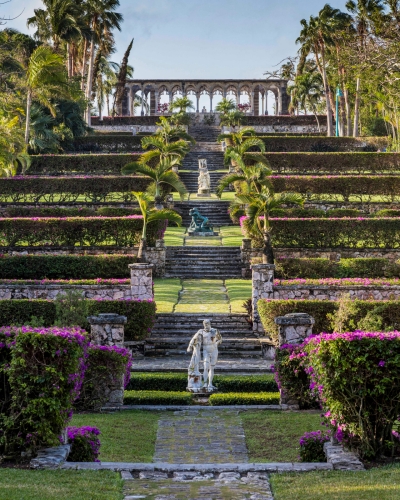
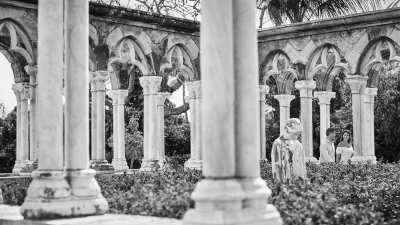
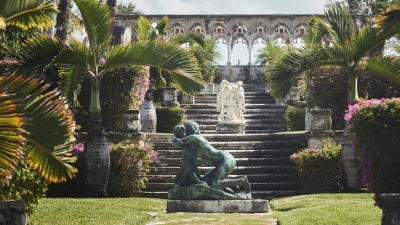
As the palms sway lithely and a warm island breeze pulls forth a sweet salty scent, find yourself basking in the expansive Versailles Terraced Gardens at The Ocean Club, A Four Seasons Resort, Bahamas. With a history that echoes the glamour and luxury for which the Resort is famed, this stretch of impeccably manicured greenswards house a personally curated collection of stone and bronze statues, ascending in a climax of fine white marble cloisters overlooking Nassau Harbour. A walk through this art evokes images of the legendary experiences for which the Resort is known.
Heir to A & P Tea Company, George Huntington Hartford II bought the property around 1960; then named Shangri La. Purchased from Swedish millionaire Wenner-Gren, Hartford envisioned a luxury estate for Hollywood and business elite. He imported European fountains and statues and petitioned the renaming of Hog Island to Paradise Island. Of the 13 statues, we highlight three along the walk.
The Reclining Venus lays peacefully sheltered from the elements and enjoys an appropriately peaceful visage in the heart of the spa. Sculpted in 1829 by one of the 18th century’s most lauded artists, Lorenzo Bartollini from Florence, Italy, Venus is impeccably etched out of Italian marble on a bed of concrete; Bartollini’s signature visible on the anterior of the prized piece. Emulating the 16th century Italian painting by Titian, this is the most revered pieces of Hartford’s collection.
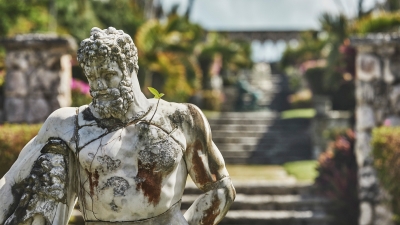
Descend past the photogenic Versailles Pool and Terrace to the third tier for a polarizing glimpse of the strength of man and the tenderness of love. Hercules commands the centre of the garden, perched by the lily pond. Considered the guardian of Mankind, his likeness here towers at eight feet (2.43 metres), with original ancient parts of the statue still visible. He was restored during the 19th century.
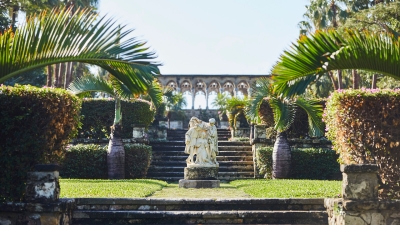
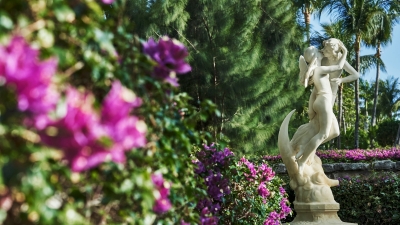
Appropriately to his left is the original story of illicit love. Cupid and Psyche enjoy a small sense of privacy at the edge of the Garden. Said to conjure the likeness of Venus, Psyche unknowingly bore the resentment of the Goddess. She sends Cupid to strike her with a cursed arrow. Taking aim, he scratches himself with the poisoned tips and falls in love with his first sight: Psyche. Cupid disobeys his mother’s commands and seeks Psyche’s hand in marriage. Forever immortalized in the Versailles Gardens, the statue of these banished lovers is crafted of marble. Constructed in 1897 by Italian sculptor Aristide Petrilli, the statue is often the backdrop of guests’ most intimate celebrations.
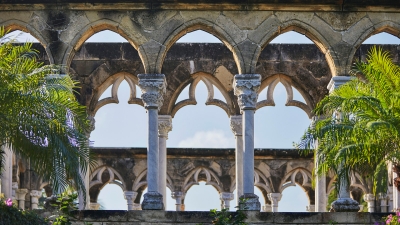
Hartford’s most iconic purchase happened in 1961 when he acquired the disassembled parts of the 12th century cloisters that seemingly sentinel the Gardens. Originally purchased from Parisian art dealers in 1924 by media mogul William Randolph Hearst, the intention was to use the columns as ornaments in his namesake castle in Northern California. Upon arrival in Brooklyn, New York in 1925, the unloaded marble pieces were mixed at customs with those of Spanish Cistercian monastery Santa Maria Real. As Heart’s fortune declined, his elaborate collections waned and the confused cloister collection sat in crates for 25 years. Between 1951 and 1961 the cloister remains were owned by three businessmen who reconstructed the Pyrenean church, but chose not to erect the cloisters. Hartford acquired them thereafter, and hired J.J. Castremanne, architect, to assemble the pieces.
The cloisters set in our Garden are a combination of more than one origin. According to a study conducted by a French doctorate student, these cloisters, “comprise an open-air, square space composed by inner and outer uncovered arcades, creating a passageway between them. The great arches spring from double capitals poised over paired columns. This large ensemble would be composed of three original hundred twenty carved pieces in white marble (capitals, columns and bases). The columns of the inner cloister are supported by tri-lobed arches, possibly original, as well as the pillars at each corner.”
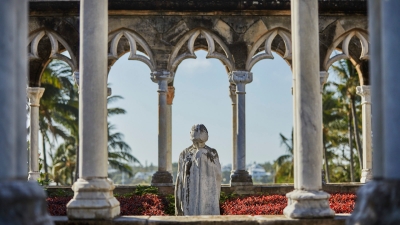
At the centre sits a marble statue in contemplation. Titled Silence, the statue was placed there by artist William Reid Dick, also cast in statue within the Garden. This marble statue was created in 1928.
We encourage you to take a stroll through these idyllic pastures and bask in this heartfelt curation of some of Europe’s finest statues.
List of Statues
Silence, 1928
- Artist: Sir William Reid Dick
- Material: Marble
- Height: 74 inches (188 centimetres)
Mother and Child, 1920
- Artist: Sir William Reid Dick
- Material: Bronze with integral base
- Height: 42 inches (107 centimetres)
- Notes: Signed and dated at base on rear, “Reid Dick 1920”
David Livingstone
- Artist: Sir William Reid Dick
- Material: Bronze on integral base with plaque
- Height: 12 feet (3.6 metres)
- Notes: Signed at base, “Reid Dick”
Franklin Deleanor Roosevelt, 1920
- Artist: Sir William Reid Dick
- Material: Bronze on integral base with plaque
- Height: 12 feet (3.6 metres)
- Notes: Signed and dated at base, “Reid Dick 1920”
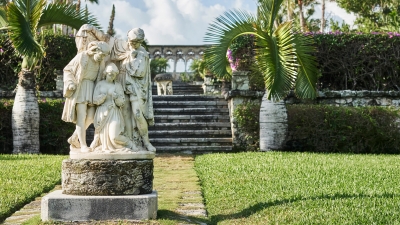
Madonna and Child with Joseph and Possible Donor
- Artist: Unknown (considered French School)
- Material: Marble on a stone base
- Height: 38 inches (91 centimetres)
- Notes: There is an illegible signature at the rear of the statue
Nymph with Dolphins, 19th century
- Artist: French or Italian School
- Material: Marble
- Height: 54 inches (137 centimetres)
Cupid and Psyche, 1897
- Artist: Aristide Petrilli
- Material: Marble on an integral marble base; placed on a concrete column not inherent to sculpture
- Height: 70 inches (178 centimetres)
- Notes: Inscribed on statue, “Risveglio Petrilli Firenze 1897”
Sundial, 19th century
- Artist: French School
- Material: Stone
- Height: 39 inches (99 centimetres)
- Notes: Faded inscription, “turn your face to the sun and the __ will fall behind you.” Four knights are visible in each corner.
Standing Female, 19th century
- Artist: French School
- Material: Stone
- Height: 45 inches (114 centimetres)
Ceres, 19th century
- Artist: French School
- Material: Stone
- Height: 50 inches (127 centimetres)
Hercules, restored in 19th century
- Artist: Italian School
- Material: Stone with ancient pieces
- Height: 8 feet (2.4 metres)
Venus and Cupid Reclined, 19th century
- Artist: French School
- Material: Marble on a concrete base
- Dimensions: 68 inches wide x 37 inches tall (172 x 94 centimetres)
The Reclining Venus, 1829
- Artist: Lorenzo Bertolini
- Material: marble with concrete base
- Dimensions: 66 inches wide s 33 inches tall (168 x 84 centimetres)
- Notes: Signed and dated on the back decorative element, “Bartolini Faceva 1829”
RELATED:

Orlando, Florida 32836
USA
The Ocean Club, A Four Seasons Resort, Bahamas
PRESS KIT